Designing IATF 16949 Traceability into Automotive Temperature Sensor Lines
EV battery BMS, drive-motor, and coolant temperature sensors are now safety-critical parts. Here are the 5 process checkpoints Tier-1 auditors expect in modern sensor manufacturing.
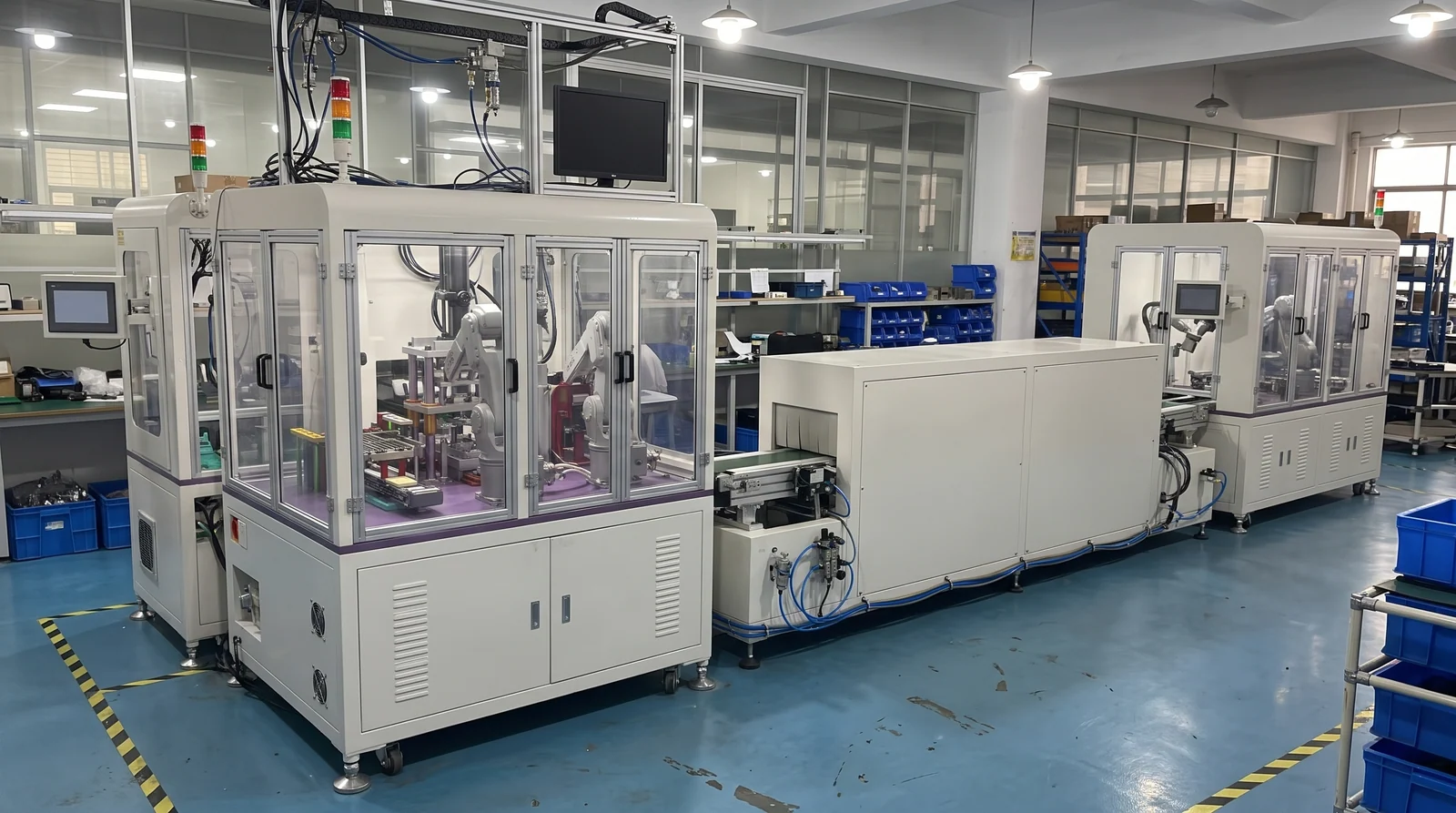
Key engineering takeaways
- Laser-etch unique DataMatrix codes before EOL testing so every serial ID binds 1:1 to Hi-Pot, resistance, and riveting force records.
- Monitor adhesive weight inline before and after potting rather than relying on periodic destructive pull checks.
- Pair 5T servo riveting force-displacement envelopes with overhead vision Poka-Yoke to prevent carrier slot mix-ups across shifts.
Why Manual Travelers Fail Modern EV & Automotive Sensor Manufacturing Audits
As electric vehicles migrate to 400V and 800V architectures, a single drifting BMS or traction motor stator temperature sensor can trigger premature power derating or miss thermal runaway onset. Consequently, Tier-1 OEMs demand full part-level backward and forward genealogy under IATF 16949 and AEC-Q200.
Batch-level paper travelers cannot isolate which 40 probes received slightly under-mixed epoxy or a drifting weld electrode at 02:15 AM. Automated sensor manufacturing lines must capture live telemetry at every critical station and mechanically lock out suspect parts before they ever reach packaging.
The 5 Mandatory Inline Traceability Checkpoints (OP140–OP360)
Across our recent 3-section automotive coolant NTC and 22,000 PCS/day EV drive-motor sensor turnkey lines, five automated verification gates deliver audit-ready compliance without slowing line takt:
- 1. Vision-Guided Pre-Weld & Post-Weld Verification: Confirms wire lead centering before DC resistance welding, logs real-time weld voltage/current/pressure curves (CR-8000 / rotary cells), and screens weld geometry via deep-learning CCD immediately afterward.
- 2. Inline Pre/Post-Dispense Weighing: Precision load cells weigh every metal housing before and after high-temp epoxy dosing, triggering automatic alarms and NG flags if adhesive mass drifts outside tolerance due to resin viscosity shifts.
- 3. Multi-Zone Curing Profile Logging: Tunnel ovens (CR-9368A) log continuous preheat (e.g., 80°C) and cure (e.g., 150°C) zone temperatures tied to carrier rack RFID/barcodes.
- 4. 5T Servo Force-Displacement Riveting: Replaces unmonitored pneumatic presses with closed-loop electric servo cylinders that plot peak force against stroke displacement on every staked sensor housing.
- 5. Laser DataMatrix Marking + 1:1 EOL Electrical Binding: Etches permanent 2D codes onto brass, stainless, or PBT+GF30 housings, grades barcode contrast via vision, and writes 100V–500V Hi-Pot and reference-calibrated resistance results straight to MES/SQL.
Connecting Multi-Brand PLCs to Plant MES Without Vendor Lock-In
Global Tier-1 plants across Mexico, Germany, Eastern Europe, and India standardize on different automation ecosystems. Our smart lines support native telemetry plugins for Siemens S7-1500/1200/400/300, Mitsubishi A-1E/MC, Omron FINS, and Modbus/OPC-UA—streaming OEE, cycle counts, alarm codes, and part genealogy directly to existing SAP, Siemens Opcenter, or custom SQL MES servers.
For semi-automated handover bays where operators still load serialized parts onto 20-slot test trays, our overhead QR Poka-Yoke vision station scans every probe and physically enforces exact slot 1–20 placement sequence so human mix-ups become impossible.
| Process Stage | Monitored Telemetry | Automated Containment Action | Audit Export Format |
|---|---|---|---|
| Micro Resistance Welding | Weld V / I / time / pressure curve | PLC flags NG slot; skips downstream potting | CSV / OPC-UA / MES API |
| Epoxy Potting & Curing | Pre/post net glue weight + oven profile | Immediate line alert + NG rejection | Lot & serial resin genealogy |
| 5T Servo Riveting | Force vs. stroke envelope curve | Hard reject chute on crush/under-stake | Curve pass/fail archive |
| Laser Marking & QR Scan | DataMatrix string + ANSI/AIM grade | No-read interlock blocks EOL pass | 1:1 Master Serial Key |
| EOL Hi-Pot & R-T Test | Leakage mA, IR MΩ, R25/R85 Ω | Mechanical NG eject + OK pass stamp | Signed COA / SQL record |
Engineering Q&A
At which step should laser QR marking occur on an automotive temperature sensor line?
Can legacy standalone machines be retrofitted with MES barcode traceability?
More engineering guides
All 7 guidesFactory Acceptance Test (FAT) & CE/UL Checklist for Sourcing Sensor Automation
Vacuum Potting Process: Eliminating Voids in Automotive NTC Sensor Epoxy
AI Visual Inspection & ±20 μm AOI for Glass & Welded NTC Sensors