Air-Based vs. Fluid-Bath Resistance Testing in NTC Sensor Manufacturing
Choosing between multi-temperature fluid baths and high-speed air chambers determines your cycle time, cleaning overhead, and R-T tolerance accuracy. Here is the engineering trade-off.
Key engineering takeaways
- Fluid baths (0°C, 25°C, or 85°C) remain mandatory whenever you verify both R25 tolerance and Beta (B-value) across tight ±0.5%–±1% curves.
- Reference-calibrated air chambers eliminate silicone oil drag-out and post-test solvent washing while scaling throughput to 3,000–4,000 PCS/H.
- Pulsed low-current measurement and Kelvin 4-wire fixtures are critical in both architectures to suppress NTC self-heating errors.
Why NTC Temperature Sensor Calibration Is Harder Than Standard Electrical Testing
Unlike fixed ohmic resistors, an NTC thermistor exhibits a steep negative exponential resistance-temperature (R-T) curve—typically changing 3% to 5% per degree Celsius around 25°C. Even a 0.2°C thermal gradient inside a test nest or slight self-heating from excessive measurement current can trigger false rejects on ±1% parts.
When factories scale past 15,000 probes per shift, end-of-line temperature sensor calibration and dielectric withstand (Hi-Pot) screening routinely become the single tightest bottleneck on the floor.
When Fluid Thermal Baths (CR-726D) Are Non-Negotiable
Precision fluid baths circulate temperature-stabilized silicone oil, water-glycol, or dielectric media within ±0.02°C to ±0.05°C uniformity. Because liquids transfer heat roughly 20–30× faster than still air, metal and overmolded probes reach thermal equilibrium reliably at dual setpoints such as 0°C & 25°C or 25°C & 85°C.
- Required when customer specifications mandate verified Beta (B25/85 or B25/50) curves alongside R25 resistance.
- Ideal for waterproof stainless steel, brass automotive oil probes, and overmolded HVAC/appliance sensors requiring ±0.5% to ±1% precision.
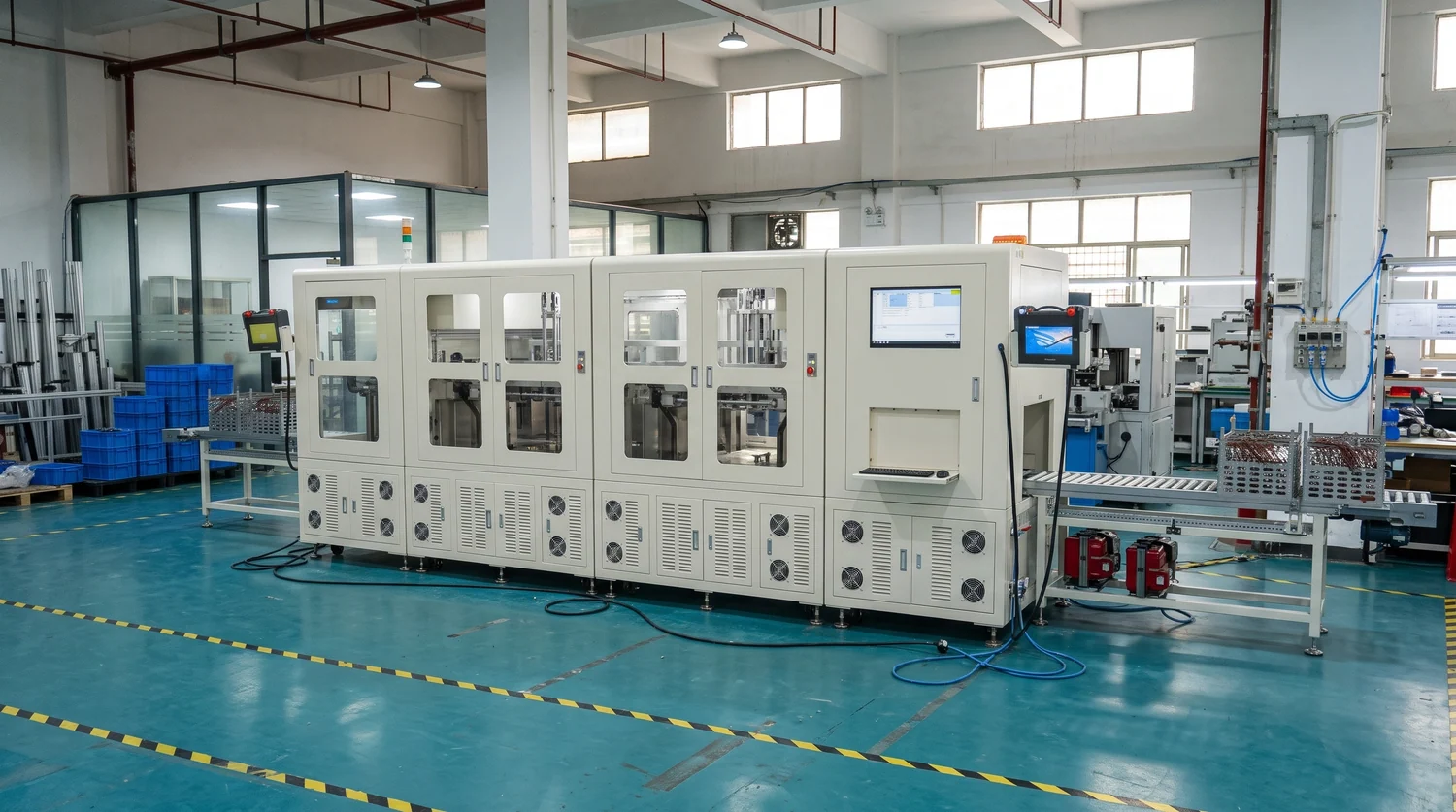
- On CR-726D systems, 60-piece fixture frames run 2,500–3,000 PCS/H with integrated Rek Hi-Pot and GW Instek GDM-9061 6.5-digit multimeters.
- Requires downstream drip recovery and ultrasonic or alcohol wash/dry cycles so finished cables ship residue-free.
When Reference-Calibrated Air Testing (CR-726D3) Wins
Many automotive connector assemblies, medical probes, and single-end dry sensors strictly prohibit oil contact—or the extra solvent-washing and drying station erodes plant margins and floor space. Our CR-726D3 air-test architecture stabilizes incoming 60-piece sensor frames alongside a calibrated golden reference probe inside a draft-shielded chamber.
By computing real-time resistance delta against the co-located golden reference—combined with high-voltage Hi-Pot screening and automatic mechanical NG cutting/ejection—factories achieve 3,000–4,000 PCS/H clean dry testing with zero chemical consumables.
Sizing Calibration Dwell Time & Total Cost of Ownership
Total cost per tested sensor is not just machine capex. A fluid-bath system consumes silicone oil replenishment, degreasing solvents, ultrasonic tank power, and operator tray transfers. Conversely, an air-based chamber saves 100% of post-test wash costs but requires stable workshop HVAC (typically 22°C–26°C without direct fan drafts) and matched thermal mass between the golden reference sensor and units under test.
During Shenzhen FAT, our engineers log Cp/Cpk repeatability across 300+ customer samples in both ambient-reference and dual-bath setups so your QA team approves measurement uncertainty before shipment.
| Parameter | Thermal Fluid Bath (CR-726D) | Stabilized Air Chamber (CR-726D3) |
|---|---|---|
| Typical Throughput | 2,500–3,000 PCS/H | 3,000–4,000 PCS/H |
| Multi-Point B-Value (0°C / 25°C / 85°C) | Native (2 or 4 baths) | Ambient reference single-point |
| Bath Uniformity / Ref Accuracy | ±0.02°C to ±0.05°C bath stability | Matched golden reference probe |
| Post-Test Cleaning Required | Yes (drip/wash/hot-air dry) | None (100% oil-free dry process) |
| Best-Fit Applications | HVAC, oil/coolant probes, ±0.5% tolerance | Single-end probes, dry connectors |
| MES Serialized Logging | Full Hi-Pot + R-T CSV/SQL/MES | Full Hi-Pot + reference delta MES |
Engineering Q&A
Can air-based testing verify tight ±1% NTC resistance tolerances?
What does ISO 9001 / IATF 16949 require for production temperature sensor calibration?
More engineering guides
All 7 guidesDesigning IATF 16949 Traceability into Automotive Temperature Sensor Lines
Factory Acceptance Test (FAT) & CE/UL Checklist for Sourcing Sensor Automation
Vacuum Potting Process: Eliminating Voids in Automotive NTC Sensor Epoxy